TL;DR
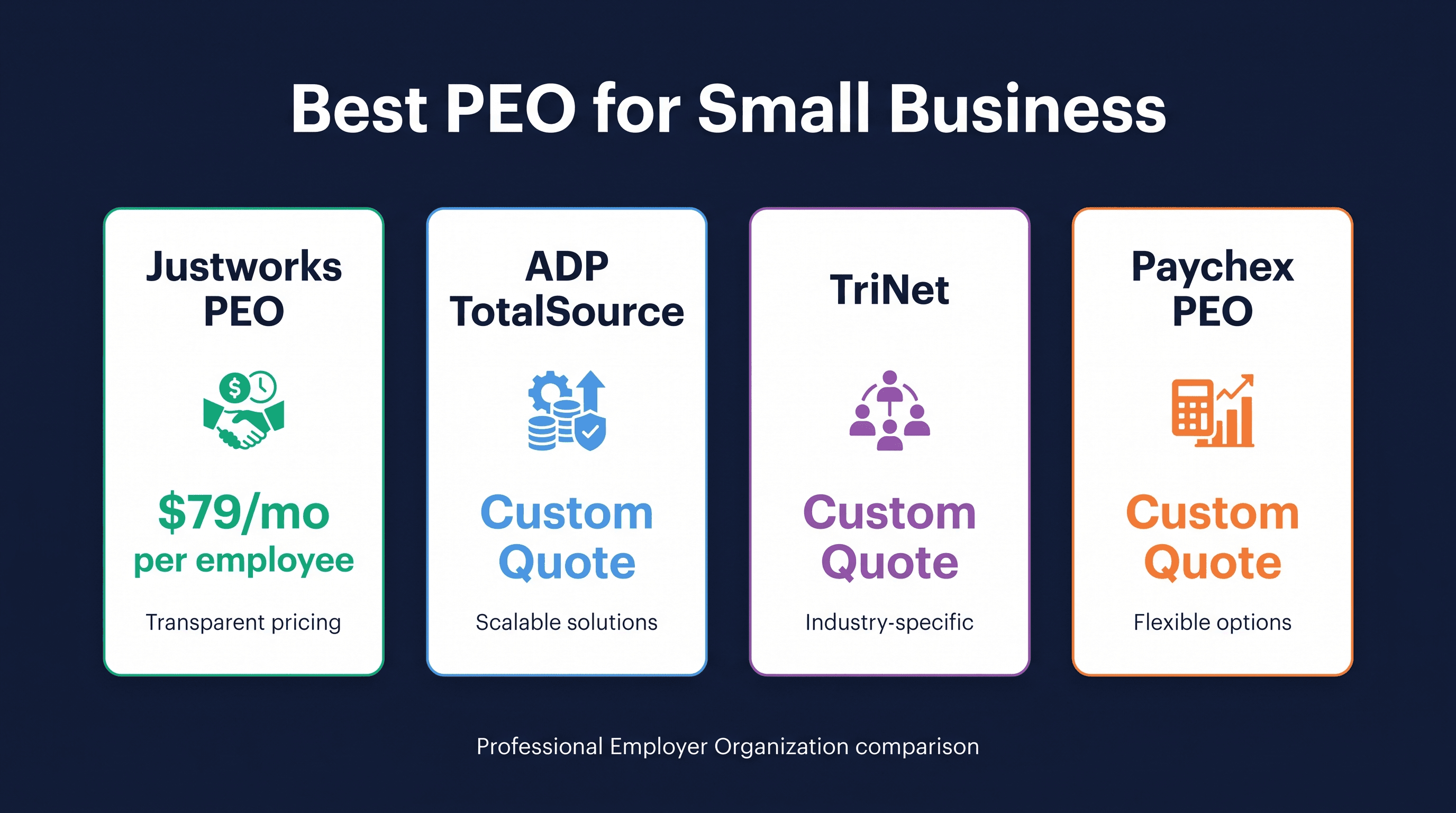
For most small businesses under 50 employees, Justworks PEO is the strongest choice because it is the only major PEO with published pricing ($79/PEPM for Basic, $124/PEPM for Plus), requires no implementation fee, and starts at 2 employees. ADP TotalSource is better if you need legally-backed HR guidance with EPLI included. TriNet fits tech and life-sciences startups that want industry-specific benefits packages. Paychex PEO and Insperity are solid options for businesses that prefer a traditional, fully-managed relationship. All except Justworks require a custom quote.
ℹ PEO vs payroll software: not the same thing
A PEO (Professional Employer Organization) is not payroll software. When you use a PEO, your employees are legally co-employed by the PEO: they appear on the PEO's payroll, receive benefits through the PEO's group plans, and the PEO files payroll taxes under its own EIN. Gusto, QuickBooks Payroll, and ADP RUN are payroll software: they process payroll on your behalf but do not co-employ your workers. If you are looking for payroll software, see our guide to the best HR software for small business instead.
What Is a PEO and How Does Co-Employment Work?
A Professional Employer Organization enters a co-employment arrangement with your business. Under that arrangement, your employees technically have two employers: you (the worksite employer, who controls their day-to-day work) and the PEO (the employer of record for tax and benefits purposes). The PEO files payroll taxes under its own Employer Identification Number, pools your employees with those of hundreds of other client companies to negotiate large-group health insurance rates, and handles HR compliance across all the states where your team works.
For small businesses, the main appeal is access to Fortune 500-level benefits at rates you could not negotiate on your own, plus professional HR infrastructure without hiring a full HR department. The tradeoff: you pay a per-employee-per-month (PEPM) fee that covers the PEO's service, and you give up some administrative control over how certain HR processes work.
Best PEOs for Small Business: At a Glance
PEO comparison for small businesses, September 2026. Pricing verified from public sources where available.
| PEO | Published price | Min. employees | IRS CPEO certified | Best for |
|---|---|---|---|---|
| Justworks | $79–$124/PEPM | 2 | Yes | Transparent pricing, small teams (2–200) |
| ADP TotalSource | Custom quote | ~5 | Yes | EPLI-backed HR guidance, mid-market |
| TriNet | Custom quote (flat PEPM) | ~5 | Yes | Tech, life sciences, professional services |
| Paychex PEO | Custom quote | ~5 | Yes | Full-service, nationwide, any industry |
| Insperity | Custom quote | 5 | Yes | Businesses wanting high-touch HR support |
✓ Why CPEO certification matters
An IRS-certified PEO (CPEO) is legally responsible for employment taxes on wages it pays. If a non-certified PEO fails to remit payroll taxes, the IRS can come after your business for those taxes. With a CPEO, that liability rests with the PEO. All five providers listed above are IRS CPEOs, but always verify: certification can lapse. Check the IRS CPEO registry at irs.gov before signing.
Justworks PEO: Best for Small Teams and Transparent Pricing
Justworks is the only major PEO that publishes its per-employee pricing without a sales call. PEO Basic costs $79/employee/month with no base fee (payroll, compliance, HR tools, 24/7 support, 401k). PEO Plus costs $124/employee/month and adds medical, dental, vision, HSA/FSA, mental health benefits, and fertility benefits. Both plans include multi-state payroll, employer payroll tax filings, W-2 and 1099 filing, workers' compensation access, and online onboarding.
Justworks PEO real monthly costs by team size, September 2026.
| Team size | PEO Basic ($79/PEPM) | PEO Plus ($124/PEPM) |
|---|---|---|
| 2 employees | $158/mo | $248/mo |
| 5 employees | $395/mo | $620/mo |
| 10 employees | $790/mo | $1,240/mo |
| 25 employees | $1,975/mo | $3,100/mo |
| 50 employees | $3,950/mo | $6,200/mo |
⚠ PEPM does not include health insurance premiums
The $79 or $124/PEPM is Justworks's service and administration fee. Health insurance premiums are a separate line item billed on top. On PEO Plus, Justworks pools your employees into its group plan, which typically cuts premiums by 20–40% versus what a 10-person team could negotiate directly. But the total monthly cost for a 10-person team on PEO Plus can easily run $2,500–$4,000/month once you add employer health contributions.
Justworks requires a minimum of 2 employees and charges no implementation fee, which is unusual among PEOs. Add-ons available on PEO plans: Dedicated HR Consulting ($30/PEPM), Time Tracking ($8/PEPM), US-based Contractor payments ($8/paid contractor/month), International Contractors ($39/paid contractor/month), and ICHRA health reimbursements via Thatch ($25/enrolled employee/month).
ADP TotalSource: Best for HR Guidance With Legal Backing
ADP TotalSource is ADP's PEO product for businesses with roughly 5 to 1,000 employees. Pricing is custom and not published. What distinguishes TotalSource from Justworks is the included Employment Practices Liability Insurance (EPLI): when an HR Business Partner gives you guidance on a termination or a harassment complaint, that advice is backed by insurance coverage. For a small business with no in-house employment attorney, that is a meaningful safety net.
ADP TotalSource is an IRS-certified CPEO and uses ADP's enterprise payroll and HR technology stack. You get the same Workforce Now platform used by mid-market companies, which is more capable and more complex than Justworks's interface. If your team has multi-state complexity, high-risk HR situations, or you want the reassurance of EPLI-backed guidance, TotalSource is worth the custom quote process. Expect to pay more than Justworks: third-party benchmarks (OutSail, Vendr) suggest $100–$160/PEPM all-in for teams under 50.
TriNet: Best for Tech, Life Sciences, and Professional Services
TriNet's main differentiator is industry specialization. Instead of one generic benefits package, TriNet offers benefits packages tuned to the specific needs of tech startups, life sciences companies, financial services firms, and nonprofit organizations. A software company's employees want different health plans, equity compensation support, and commuter benefits than a medical device company's workforce. TriNet structures its offerings around those vertical needs.
TriNet uses a flat PEPM pricing model rather than a percentage-of-payroll model. That means your administrative fees do not increase when you give someone a raise, and charges automatically decrease when employees hit Social Security or unemployment tax ceilings. No pricing is published; expect to request a quote. TriNet's 2024 Forrester TEI study (commissioned by TriNet) reported a 66% ROI over three years, but treat that figure as directional rather than guaranteed. A commissioned study is not an independent audit.
Paychex PEO: Best for Full-Service, Any Industry
Paychex PEO assigns each client a four-person team: a Client Advocate (main point of contact), an HR Business Partner (dedicated HR professional), a Safety Specialist (for clients on the Paychex workers' comp policy), and a Payroll Specialist. Paychex files payroll taxes under its own EIN and includes workers' compensation administration and claims management in the PEO relationship. No pricing is published.
One thing to note: Paychex acquired Paycor in 2024. The combined entity now covers everything from small-business payroll (Paychex Flex) to mid-market HRIS (Paycor) to full PEO services. This gives Paychex a broader technology portfolio than before, but also means the product roadmap for both platforms is still being integrated. If you are already a Paychex Flex customer and growing toward PEO territory, TotalSource or TriNet are worth comparing directly before defaulting to Paychex PEO by convenience.
Insperity: Best for High-Touch HR Support
Insperity targets businesses with 5 to 149 employees and positions itself at the premium end of the PEO market. No pricing is published. Insperity's reputation is for strong, proactive HR consulting: dedicated HR specialists who reach out to clients rather than waiting to be called. If you want a PEO that functions more like an embedded HR team than a software platform with support tiers, Insperity is worth including in your shortlist. Third-party benchmarks suggest $130–$180/PEPM for small teams.
When a PEO Makes Sense (and When It Does Not)
A PEO makes the most sense when: you have 5 or more W-2 employees and need to offer competitive health benefits; you operate across multiple US states and compliance complexity is growing faster than your HR bandwidth; or a major benefits expense (health insurance) would cost 20–40% less through a PEO's group buying power than through a broker directly.
A PEO does not make sense when: your workforce is mostly contractors or part-time staff with no benefits eligibility; you have fewer than 5 employees and the minimum PEPM fees make the math unfavorable; your team is primarily international (where EOR services like Deel or Remote are the right tool, not a PEO); or you are in a very high-risk industry like construction or agriculture where workers' comp rates may make PEO insurance pools unworkable.
ℹ PEO vs EOR: different problems
A PEO works for US employees only. If you need to legally employ workers in other countries, you need an Employer of Record (EOR) like Deel or Remote. EOR services handle international employment without requiring you to set up a local legal entity. See our guide to PEO vs EOR for the full breakdown.
How to Calculate What a PEO Actually Costs Your Business
The PEPM fee is only part of the cost. A full PEO cost calculation for a 10-person team on Justworks PEO Plus looks like this: $124 x 10 = $1,240/month for the service fee. Employer health insurance contributions (if you cover 70% of premiums on a $600/month plan): $420 x 10 = $4,200/month. 401k employer match (if 3%): depends on payroll. Total before 401k: roughly $5,440/month for 10 employees, or $6,528/year per employee. That sounds expensive, but compare it to what you would pay a benefits broker, plus a payroll provider, plus an HR consultant on retainer. For many 10–50 person companies, the PEO bundle costs less than the sum of those parts.
When to Leave a PEO
Most PEO relationships make economic sense up to roughly 100–200 employees. Beyond that threshold, your company is large enough to negotiate its own group health insurance rates that rival what the PEO pool offers. You can hire a dedicated HR team and benefits administrator for less than the PEPM fees. If your headcount crosses 150 and you are paying a PEO, run the build-vs-buy analysis. Many companies that outgrow a PEO find the transition smoother if they have kept their own HRIS data clean throughout the PEO relationship.
Frequently Asked Questions
Justworks PEO requires a minimum of 2 employees, which is the lowest threshold among major PEOs. Most others (ADP TotalSource, TriNet, Paychex PEO, Insperity) require 5 or more. Below 5 employees, the per-employee fees often make a PEO economically unfavorable compared to a simple payroll provider plus a benefits broker.
Tools Mentioned

US-based small businesses (1–100 employees), solo owners, and S corps
$49/month + $6/person· 0-day trial

Scaling companies (30–10,000 employees) with remote or hybrid teams
Custom quote (demo required)

Companies hiring international employees or contractors in multiple countries
$49/contractor/month

Mid-market and enterprise companies (50–10,000+ employees) with complex multi-state payroll
Custom quote

Growing companies (10–500 employees) that want modular HR without a fixed bundle
$8/user/month