TL;DR
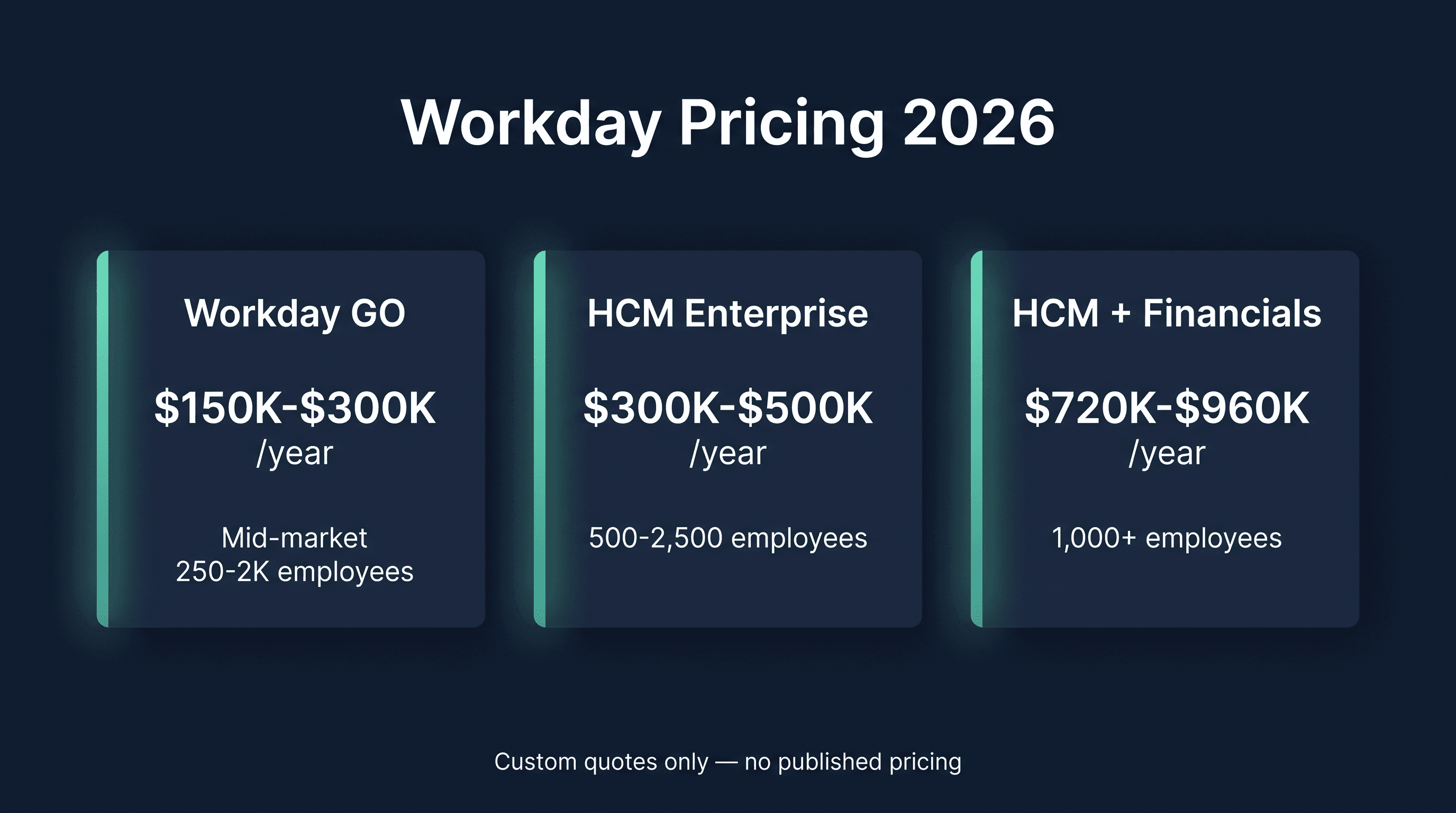
Workday does not publish pricing. Based on third-party procurement data and buyer reports: the per-employee-per-month (PEPM) rate ranges from $34 to $100 depending on modules and headcount. By annual cost: teams under 500 employees typically pay $150K-$300K per year; 500-2,500 employees pay $300K-$500K per year. The median Workday contract across thousands of transactions is approximately $49,795 per year (Vendr, via ERPResearch). Implementation adds another 100-150% of the annual subscription in year one, making total first-year cost 2.5-3x the subscription alone. Workday targets organizations with 250 or more employees. If your team has fewer than 250 people, Workday is almost certainly not the right tool.
Workday is one of the most recognized names in enterprise HR software, and one of the most opaque on price. Unlike Gusto ($49/month plus $6 per employee, listed on their pricing page) or Justworks ($79/month per employee, also public), Workday will not tell you what the software costs until you sit through a discovery call and demo. This is a deliberate sales strategy. It also means that anyone trying to evaluate Workday against alternatives has to work from third-party data, buyer interviews, and procurement benchmarks to get a realistic number.
This post compiles what Workday actually costs, based on published buyer data from OutSail, ERPResearch, CheckThat.ai, and third-party procurement benchmarks from Vendr, all verified September 2026. Numbers are attributed to sources throughout. Where Workday's pricing is genuinely unknown, we say so.
How Workday Charges: The PEPM Model
Workday uses a per-employee-per-month (PEPM) pricing model based on total employee headcount, not the number of users who log into the system. This distinction matters more than it sounds.
⚠ You pay for every employee, not just system users
If your company has 800 employees and your HR team of 12 uses Workday daily while warehouse staff rarely log in, you pay for all 800. The PEPM rate applies to total headcount. Companies with large hourly or seasonal workforces should model this carefully before requesting a quote.
PEPM rates vary based on three main factors: the modules you license (HCM alone vs. HCM plus Financial Management vs. the full suite), your total employee count (volume discounts compress the per-employee rate at higher headcounts), and your contract term (3-year is standard; 5-year unlocks better rates). The PEPM rate is never the full story. Implementation, training, and optional add-ons all layer on top.
What Workday Costs by Company Size (Annual Subscription)
The table below draws from OutSail's buyer data and ERPResearch's procurement benchmarks. These are subscription costs only and do not include implementation, training, or change management.
Workday HCM annual subscription estimates by company size. Sources: OutSail.co and ERPResearch.com, September 2026. Subscription only, not including implementation or training.
| Company size | Annual subscription (estimate) | PEPM range | Notes |
|---|---|---|---|
| Under 500 employees | $150K-$300K/year | $34-$50 PEPM | Workday GO mid-market product; newer streamlined implementation |
| 500-2,500 employees | $300K-$500K/year | $30-$42 PEPM at scale | Core target segment; HCM + Payroll typical |
| 1,000-5,000 employees | $100K-$200K annual subscription (HCM) | $30-$40 PEPM | Mid-market band per CheckThat.ai; enterprise SI typically required |
| 5,000+ employees | $408-$504 per employee per year | $34-$42 PEPM | Enterprise volume discount; total contract value grows with headcount |
| Large enterprise (HCM + Financials) | $720K-$960K/year | $60-$80 PEPM | Combined modules at 1,000 employees; ERPResearch estimate |
The median Workday contract across thousands of third-party procurement transactions is approximately $49,795 per year, with real deals ranging from $19,240 to $536,508 per year depending on modules and company size (ERPResearch, citing Vendr procurement data). The broad range reflects that smaller mid-market customers on Workday GO and large enterprise deployments sit at completely different price points.
Workday GO: The Mid-Market Option
Workday historically required a minimum annual contract value of $250K, which made it inaccessible to companies under 500 employees. That minimum has been removed. Workday now offers Workday GO, a streamlined configuration designed for companies with roughly 250-2,000 employees.
- •Implementation timeline: 3 months for HCM, 4 months for HCM plus Payroll. This compares to 6-10 months for full enterprise Workday deployments.
- •Pricing: some mid-market customers are now seeing annual costs in the $100K-$200K range, down from the historical $250K+ floor.
- •Scope: Workday GO is a more constrained configuration than full Workday. It covers core HCM, payroll, and benefits but with less custom workflow complexity than enterprise deployments.
- •Trade-off: you still need an implementation partner, and the software is still priced for companies that take HR seriously as a business function, not for companies that want basic payroll at the lowest cost.
ℹ Workday GO vs. Workday (enterprise): key difference
Workday GO is the mid-market entry point with a faster, lower-cost implementation methodology. Full Workday is the enterprise product with unlimited configuration, deeper Financial Management integration, and global deployment capabilities. Both use the same core Workday platform and the same PEPM pricing model. The distinction is implementation approach and scope, not a separate product tier with different features.
Module Pricing: What Each Add-On Costs
Workday sells modules separately. Most organizations start with HCM (HR, payroll, benefits) and add modules over time. Workday Adaptive Planning is the most common add-on and is always priced separately from core HCM.
Workday module pricing estimates, September 2026. Sources: CheckThat.ai and ERPResearch. All Workday pricing is custom-quoted and these figures are third-party estimates, not published prices.
| Module | Estimated cost | What it covers |
|---|---|---|
| HCM Suite | $96-$504/employee/year | Recruiting, onboarding, payroll, benefits, performance, workforce planning |
| Financial Management | Custom quoted (separate from HCM PEPM) | General ledger, accounts payable/receivable, procurement, revenue management |
| Workday Adaptive Planning | $20-$40/employee/year (add-on) | Budgeting, forecasting, scenario modeling; billed separately from core HCM |
| Workday Extend | Negotiated separately | Low-code/no-code custom application development on the Workday platform |
| Workday Prism Analytics | Add-on, custom quoted | Advanced analytics and data integration beyond core Workday reporting |
The Hidden Cost That Surprises Every Buyer: Implementation
Workday's annual subscription is not what Workday costs in year one. Implementation is the largest variable cost and it is substantial. According to OutSail and ERPResearch, implementation typically runs 100-150% of the annual subscription fee. For a $300K/year subscription, budget $300K-$450K for implementation alone.
Workday year-one total cost of ownership by company size. Implementation estimated at 100-150% of annual subscription. Sources: OutSail.co, CheckThat.ai, ERPResearch.com.
| Company size | Annual subscription (est.) | Implementation (est.) | Training/change mgmt (est.) | Year-1 total |
|---|---|---|---|---|
| Under 500 employees (Workday GO) | $100K-$200K | $100K-$200K | $15K-$50K | $215K-$450K |
| 500-2,500 employees | $300K-$500K | $300K-$500K | $50K-$100K | $650K-$1.1M |
| 1,000-5,000 employees | $100K-$200K subscription | $100K-$200K | $15K-$50K | $215K-$450K |
| 5,000+ employees (enterprise) | $2M-$2.5M | $2M-$3M | $150K-$250K | $4.15M-$5.75M |
Implementation partners charge between $105 and $180 per hour for independent Workday consultants and between $250 and $1,000 per hour for Big 4 firms (Deloitte, PwC, EY, KPMG), according to published rate data from Accenture and independent contractors (CheckThat.ai, September 2026). Enterprise global rollouts have been reported at $5M-$10M in implementation costs alone. Most mid-market implementations require a certified global SI partner, not internal IT.
Contract Terms and Negotiation Points
- •Minimum term: 3 years is Workday's standard contract length. 5-year contracts unlock lower PEPM rates but reduce flexibility.
- •True-up clauses: if your headcount grows during the contract, Workday re-prices the additional employees at the contracted PEPM rate. Shrinking headcount does not automatically reduce your bill mid-term. Understand the headcount band you are contracting for before signing.
- •Annual uplift: contracts typically include an annual price increase cap, usually tied to CPI or a fixed percentage. Negotiate this cap explicitly.
- •Early termination: Workday contracts include termination fees. Confirm the exact calculation before signing.
- •Implementation separate: your Workday subscription contract does not cover implementation costs. Implementation is a separate contract with Workday or a certified SI partner.
- •Negotiation leverage: Workday sales operates on quarterly close targets. End-of-quarter negotiations often produce better rates, additional implementation credits, or extended free periods.
Workday vs. Alternatives on Annual Cost
Annual HR software cost comparison at 250 employees, September 2026. Workday figures are third-party estimates. All other figures are calculated from published vendor pricing.
| Software | Annual cost (250 employees) | Published pricing | Free trial | Target company size |
|---|---|---|---|---|
| Gusto Plus | $264,000/year ($1,100 base + $80/person/mo) | Yes | 30 days | Under 200 employees |
| BambooHR Pro | $51,000/year ($17/person/mo) | Base tier only | 7 days | 25-1,000 employees |
| Rippling HR + Payroll (est.) | $75,000-$105,000/year (~$25-35 PEPM) | Core HR only | No | 10-1,000 employees |
| ADP Workforce Now (est.) | $120,000-$250,000/year (custom quote) | No | No | 50-10,000 employees |
| Workday GO (est.) | $150,000-$300,000/year | No | No | 250-2,000 employees |
| Workday Enterprise (est.) | $300,000-$500,000/year | No | No | 1,000+ employees |
⚠ Under 250 employees? Read this before requesting a Workday demo
At 250 employees, Gusto Plus costs approximately $22,000/year. Workday GO starts at approximately $150,000/year, based on third-party data. That is a 6-7x premium. Workday adds real value: unified HCM and financials, deeper analytics, enterprise-grade permissions and audit trails, and global capabilities. But if your core need is payroll, benefits, and basic HR for a US-based team, you are paying for capabilities you will not use for years. BambooHR Pro ($51,000/year at 250 employees) and Rippling ($75K-$105K/year estimated) sit between Gusto and Workday and handle mid-market complexity at lower cost.
When Workday Is the Right Choice
- •You need unified HCM and Financial Management on a single platform: Workday's core architectural advantage is that HR, payroll, and finance run on one system with no data sync required. If you run separate HRIS, payroll, and ERP tools and the reconciliation overhead is a real problem, Workday's unified approach has genuine ROI.
- •Your organization has 250 or more employees with complex HR workflows: multi-entity structures, global headcount, role-based access at scale, and compliance across multiple jurisdictions are where Workday's configuration depth pays off.
- •Your industry requires enterprise-grade audit trails and permissions: healthcare, financial services, and higher education commonly run Workday because the compliance and audit capabilities exceed what mid-market tools offer.
- •You have dedicated HRIS staff: Workday requires ongoing administration. Most customers with 500 or more employees have at least one full-time Workday administrator. Factor that salary into the TCO.
- •You are evaluating 3-5 year platform stability: Workday's SaaS model delivers twice-yearly updates, and the platform is unlikely to be acquired or sunset. For organizations making a long-term infrastructure decision, Workday's stability is a legitimate factor.
When to Look at Alternatives Instead
- •Under 250 employees with US-only payroll: Gusto Simple ($109/month for 10 employees, pricing published) or BambooHR Core ($10/employee/month) handle this use case at a fraction of Workday's cost and can be evaluated without a sales call.
- •Under 50 employees needing payroll only: Gusto, QuickBooks Payroll, or Roll by ADP are designed for this segment and offer free trials. Workday is not.
- •Mid-market with global hiring but no HCM complexity: Rippling handles US payroll and global EOR ($499-599/month per international employee) without Workday's enterprise price tag or implementation timeline.
- •You need a free trial: Workday does not offer one. If hands-on evaluation before contract signing is a requirement, Gusto (30 days), BambooHR (7 days), or Rippling (demo with sandbox) are accessible without a sales commitment.
- •Budget under $100K per year for HR software: Workday's realistic floor for teams under 500 employees is $150K/year in subscription costs, plus implementation. If that does not fit the budget, the right answer is not to negotiate harder but to select a different category of tool.
Frequently Asked Questions
Workday charges on a per-employee-per-month (PEPM) model based on total headcount, not just system users. Third-party data puts the PEPM range at $34-$42 for HCM at scale (OutSail), or $35-$100 PEPM including Financial Management and other modules (ERPResearch). HCM-only at enterprise scale sits at the lower end. Adding Financial Management, Adaptive Planning, or Payroll increases the effective PEPM. For a 1,000-person company with HCM and Financials combined, the estimated PEPM is $60-$80, totaling $720K-$960K annually.
Tools Mentioned

Scaling companies (30–10,000 employees) with remote or hybrid teams
Custom quote (demo required)

Mid-size companies (25–500 employees) focused on people and performance
$10/employee/month (Core): Payroll add-on requires quote· 7-day trial

Mid-market and enterprise companies (50–10,000+ employees) with complex multi-state payroll
Custom quote

US-based small businesses (1–100 employees), solo owners, and S corps
$49/month + $6/person· 0-day trial

Companies with 50–500 employees needing analytics-heavy HR and payroll
Custom quote